
Water, Waste and Sewer Advisory Committee Meeting
A Water, Waste and Sewer Advisory Committee Meeting of
Byron Shire Council will be held as follows:
|
Venue
|
Conference Room, Station Street, Mullumbimby
|
|
Date
|
Thursday, 29 April 2021
|
|
Time
|
9.00am
|
Phillip Holloway
Director Infrastructure
Services I2021/648
Distributed
22/04/21
What is a “Conflict of Interests” - A conflict of
interests can be of two types:
Pecuniary - an interest that a person has in a matter because of a reasonable
likelihood or expectation of appreciable financial gain or loss to the person
or another person with whom the person is associated.
Non-pecuniary – a private or personal interest that a Council
official has that does not amount to a pecuniary interest as defined in the
Code of Conduct for Councillors (eg. A friendship, membership of an
association, society or trade union or involvement or interest in an activity
and may include an interest of a financial nature).
Remoteness – a person does not have a pecuniary interest in a matter
if the interest is so remote or insignificant that it could not reasonably be
regarded as likely to influence any decision the person might make in relation
to a matter or if the interest is of a kind specified in the Code of Conduct
for Councillors.
Who has a Pecuniary Interest? - a person has a pecuniary interest in a
matter if the pecuniary interest is the interest of the person, or another
person with whom the person is associated (see below).
Relatives, Partners - a person is taken to have a pecuniary
interest in a matter if:
·
The
person’s spouse or de facto partner or a relative of the person has a
pecuniary interest in the matter, or
·
The
person, or a nominee, partners or employer of the person, is a member of a
company or other body that has a pecuniary interest in the matter.
N.B. “Relative”, in relation to a person means any of the
following:
(a) the parent,
grandparent, brother, sister, uncle, aunt, nephew, niece, lineal descends or
adopted child of the person or of the person’s spouse;
(b) the spouse
or de facto partners of the person or of a person referred to in paragraph (a)
No Interest in the Matter - however, a person is not taken to have a
pecuniary interest in a matter:
·
If
the person is unaware of the relevant pecuniary interest of the spouse, de
facto partner, relative or company or other body, or
·
Just
because the person is a member of, or is employed by, the Council.
·
Just
because the person is a member of, or a delegate of the Council to, a company
or other body that has a pecuniary interest in the matter provided that the
person has no beneficial interest in any shares of the company or body.
Disclosure and participation in meetings
·
A
Councillor or a member of a Council Committee who has a pecuniary interest in
any matter with which the Council is concerned and who is present at a meeting
of the Council or Committee at which the matter is being considered must
disclose the nature of the interest to the meeting as soon as practicable.
·
The
Councillor or member must not be present at, or in sight of, the meeting of the
Council or Committee:
(a) at
any time during which the matter is being considered or discussed by the
Council or Committee, or
(b) at
any time during which the Council or Committee is voting on any question in
relation to the matter.
No Knowledge - a person does not breach this Clause if the person did
not know and could not reasonably be expected to have known that the matter
under consideration at the meeting was a matter in which he or she had a
pecuniary interest.
Non-pecuniary Interests - Must be disclosed in meetings.
There are a broad range of options available for managing conflicts &
the option chosen will depend on an assessment of the circumstances of the
matter, the nature of the interest and the significance of the issue being
dealt with. Non-pecuniary conflicts of interests must be dealt with in at
least one of the following ways:
·
It
may be appropriate that no action be taken where the potential for conflict is
minimal. However, Councillors should consider providing an explanation of
why they consider a conflict does not exist.
·
Limit
involvement if practical (eg. Participate in discussion but not in decision
making or vice-versa). Care needs to be taken when exercising this
option.
·
Remove
the source of the conflict (eg. Relinquishing or divesting the personal
interest that creates the conflict)
·
Have
no involvement by absenting yourself from and not taking part in any debate or
voting on the issue as of the provisions in the Code of Conduct (particularly
if you have a significant non-pecuniary interest)
RECORDING OF VOTING ON PLANNING MATTERS
Clause 375A of the Local Government Act
1993 – Recording of voting on planning matters
(1) In this section, planning
decision means a decision made in the exercise of a function of a council
under the Environmental Planning and Assessment Act 1979:
(a) including a decision relating to
a development application, an environmental planning instrument, a development
control plan or a development contribution plan under that Act, but
(b) not including the making of an
order under that Act.
(2) The general manager is required
to keep a register containing, for each planning decision made at a meeting of
the council or a council committee, the names of the councillors who supported
the decision and the names of any councillors who opposed (or are taken to have
opposed) the decision.
(3) For the purpose of maintaining
the register, a division is required to be called whenever a motion for a
planning decision is put at a meeting of the council or a council committee.
(4) Each decision recorded in the
register is to be described in the register or identified in a manner that
enables the description to be obtained from another publicly available
document, and is to include the information required by the regulations.
(5) This section extends to a meeting
that is closed to the public.
BUSINESS OF MEETING
1. Apologies
2. Declarations
of Interest – Pecuniary and Non-Pecuniary
3. Adoption of Minutes from
Previous Meetings
3.1 Adoption
of Minutes from Previous Meeting.............................................................. 5
4. Staff Reports
Sustainable Environment and
Economy
4.1 DA
water........................................................................................................................ 13
Infrastructure Services
4.2 Mullumbimby
Future Water Strategy........................................................................ 39
4.3 Byron
STP Condition 9 Additional Load - Quarterly Report.................................. 48
4.4 Ocean
Shores transfer to Brunswick Valley STP................................................... 51
4.5 Inflow
and Infiltration - April 2021 update................................................................. 54
4.6 Item
for discussion - HuskeeSwap............................................................................ 60
Adoption of Minutes from Previous Meetings 3.1
Adoption of Minutes from Previous Meetings
Report No. 3.1 Adoption of
Minutes from Previous Meeting
Directorate: Infrastructure Services
Report Author: Dominika
Tomanek, Executive Assistant Infrastructure Services
File No: I2021/631
RECOMMENDATION:
That the minutes of the Water, Waste and Sewer Advisory
Committee Meeting held on 18 February 2021 be confirmed.
Attachments:
1 Minutes
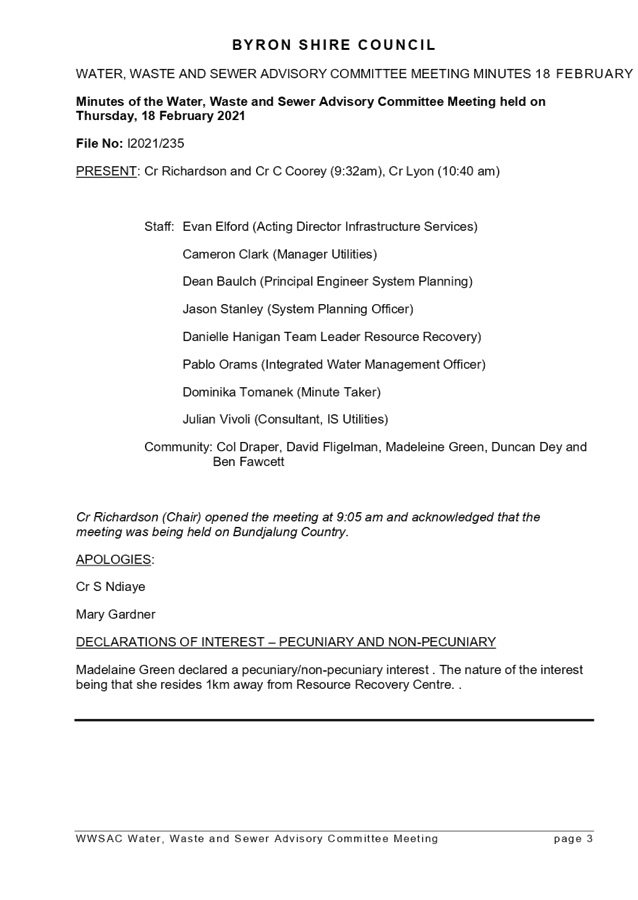
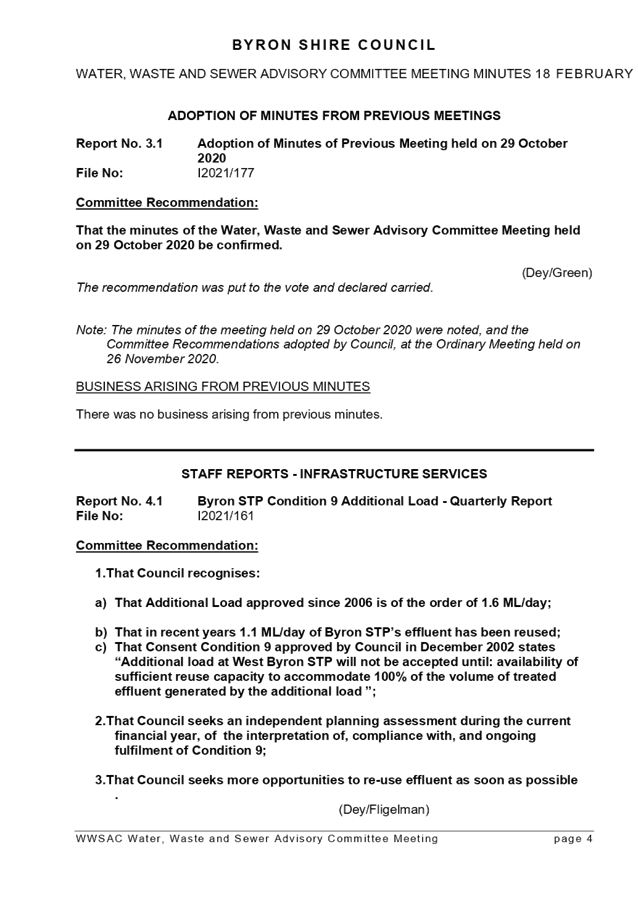
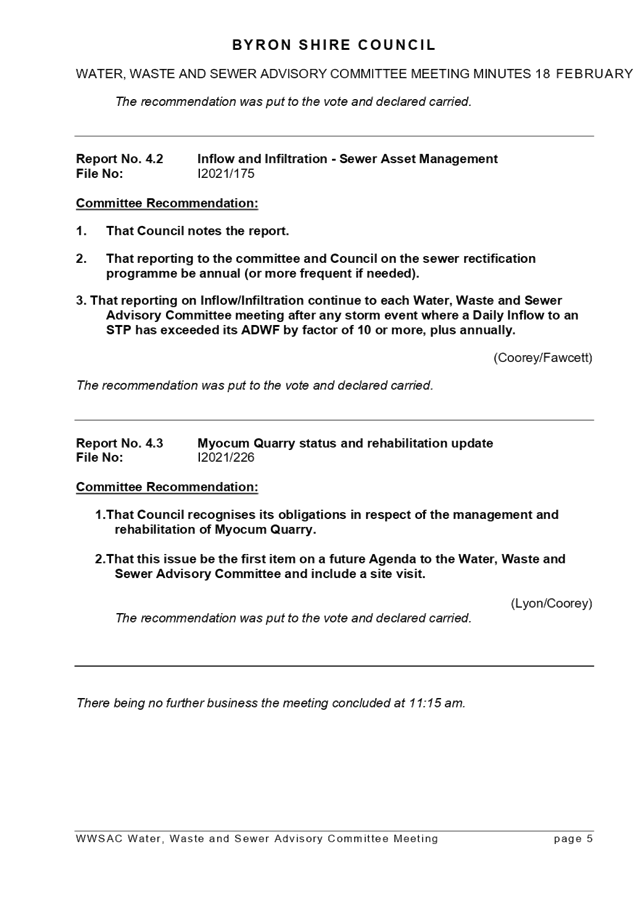
18/02/2021 Water, Waste and Sewer Advisory Committee, I2021/235 , page 8⇩ 
Report
The attachment to this report provides the minutes of the
Water, Waste and Sewer Advisory Committee Meeting of 18 February 2021 .
Report to Council
The minutes were reported to Council on 25 March 2021
without changes.
Comments
In accordance with the Committee Recommendations, Council
resolved the following:
|
21-096
|
Resolved that Council adopt the following
Committee Recommendations:
Report No. 4.1 Byron
STP Condition 9 Additional Load - Quarterly Report
File No:
I2021/161
Committee
Recommendation 4.1.1
1. That
Council recognises:
a) That
Additional Load approved since 2006 is of the order of 1.6 ML/day;
b) That
in recent years 1.1 ML/day of Byron STP’s effluent has been reused;
c) That
Consent Condition 9 approved by Council in December 2002 states
“Additional load at West Byron STP will not be accepted until:
availability of sufficient reuse capacity to accommodate 100% of the volume
of treated effluent generated by the additional load ”;
2. That
Council seeks an independent planning assessment during the current financial
year, of the interpretation of, compliance with, and ongoing fulfilment
of Condition 9;
3. That
Council seeks more opportunities to re-use effluent as soon as possible
|
|
21-097
|
Resolved that Council adopt the following
Committee Recommendations:
Report No. 4.2 Inflow
and Infiltration - Sewer Asset Management
File No:
I2021/175
Committee
Recommendation 4.2.1
1. That
Council notes the report.
2. That
reporting to the committee and Council on the sewer rectification programme
be annual (or more frequent if needed).
3. That
reporting on Inflow/Infiltration continue to each Water, Waste and Sewer
Advisory Committee meeting after any storm event where a Daily Inflow to an
STP has exceeded its ADWF by factor of 10 or more, plus annually.
|
|
21-098
|
Resolved that Council adopt the following
Committee Recommendations:
Report No. 4.3 Myocum Quarry status and rehabilitation
update
File No:
I2021/226
Committee
Recommendation 4.3.1
1. That
Council recognises its obligations in respect of the management and
rehabilitation of Myocum Quarry.
2. That
this issue be the first item on a future Agenda to the Water, Waste and Sewer
Advisory Committee and include a site visit.
|
Adoption
of Minutes from Previous Meetings 3.1 - Attachment 1
Staff Reports - Sustainable Environment and Economy 4.1
Staff Reports - Sustainable Environment and
Economy
Report No. 4.1 DA
water
Directorate: Sustainable
Environment and Economy
Report Author: Cameron
Clark, Manager Utilities
File No: I2021/565
Summary:
The purpose of this report is to respond to questions raised
by Mr Duncan Dey and Cr Cate Coorey in relation to the process of how advice to
developer’s works and what sewer load does Council think should be
catered for from the hospital precinct at the western end of Ewingsdale Road?
The process of referrals is as follows:
1. Development applications
(DA) are referred to water and sewer engineers for comment where there is
likely to be an increase in load or a structural impact on the water and sewage
infrastructure including, mains, reservoirs, pump stations and treatment
plants.
2. If the DA is to be
approved – Conditions are recommended to require a certificate of
compliance under the terms of the Water Management Act 2000. Conditions may be
imposed to:
a. to
pay a specified amount to the water supply authority by way of contribution
towards the cost of such water management works as are specified in the notice,
being existing works or projected works, or both,
b. to construct water
management works to serve the development.
3. If refused – and
there is water and sewer matters that are reasons for refusal then they are
incorporated into the reasons for refusal.
The Utilities Systems Planning Engineers are responsible for
assessing the DA under the adopted equivalent tenement policy (ET Policy) and
the development servicing plans (DSP). The DSP sets the rate of the
contribution and the ET policy determines the level of demand. The
engineers are also responsible for assessing the available capacity in the
network to service the development. This includes downstream pump
stations and the treatment plant. Where a new pump station or main is required
it must have sufficient capacity to cater for the design capacity of the
upstream mains and pump stations in the network.
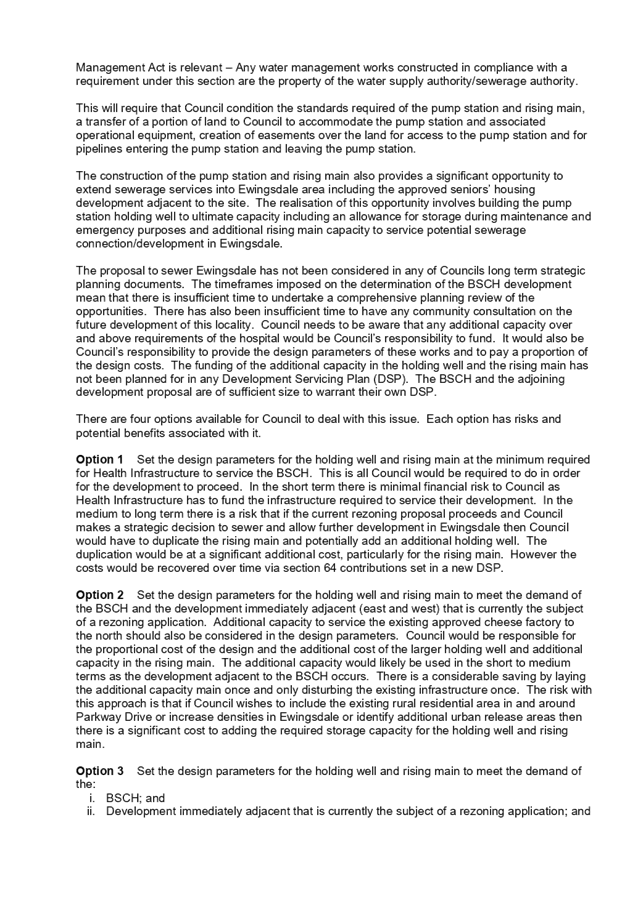
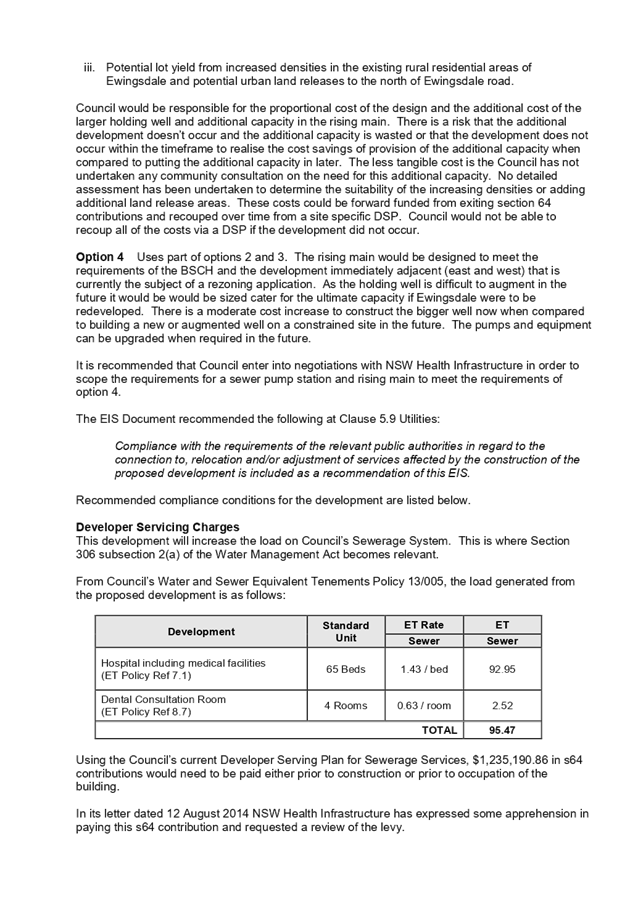
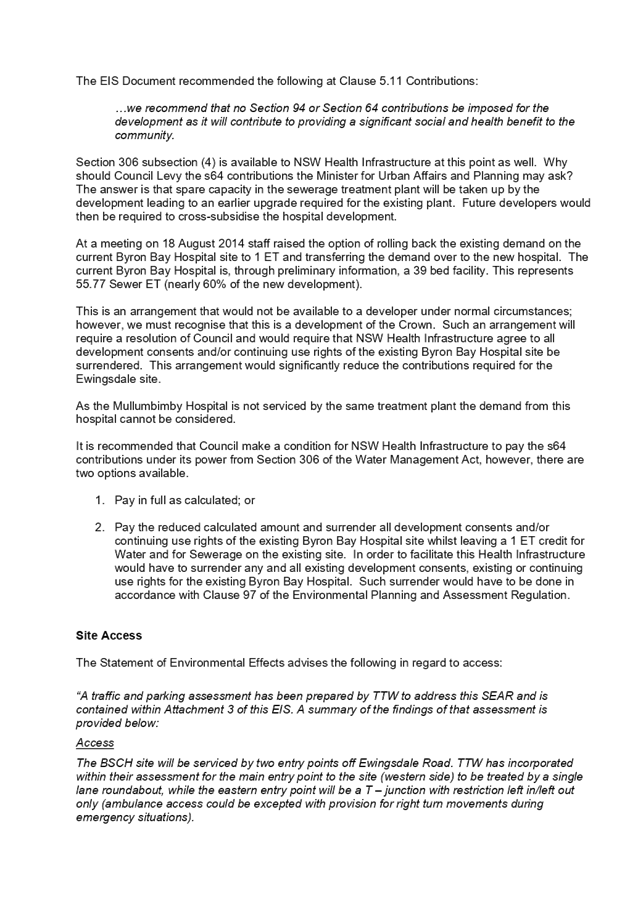
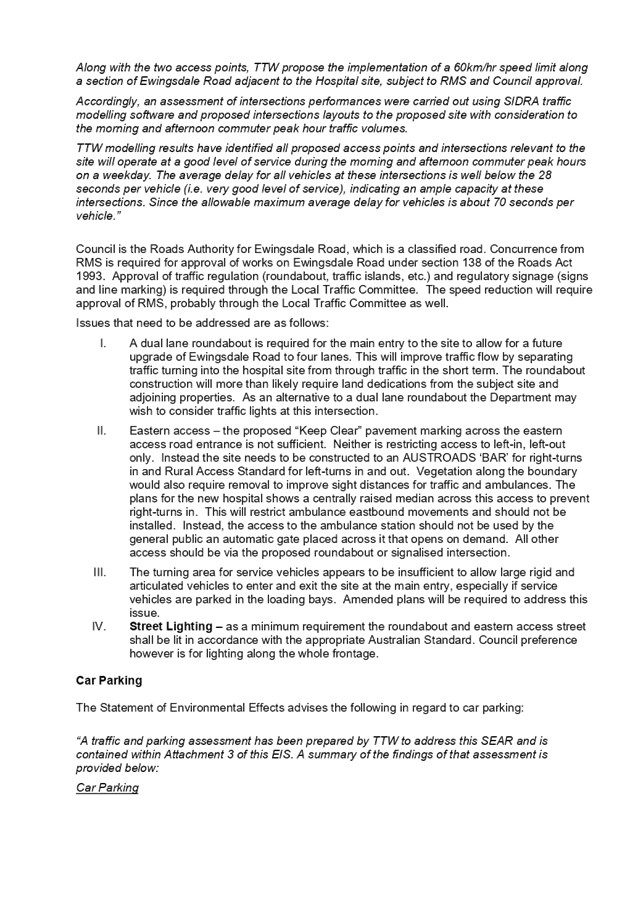
Byron Central Hospital Pump Station
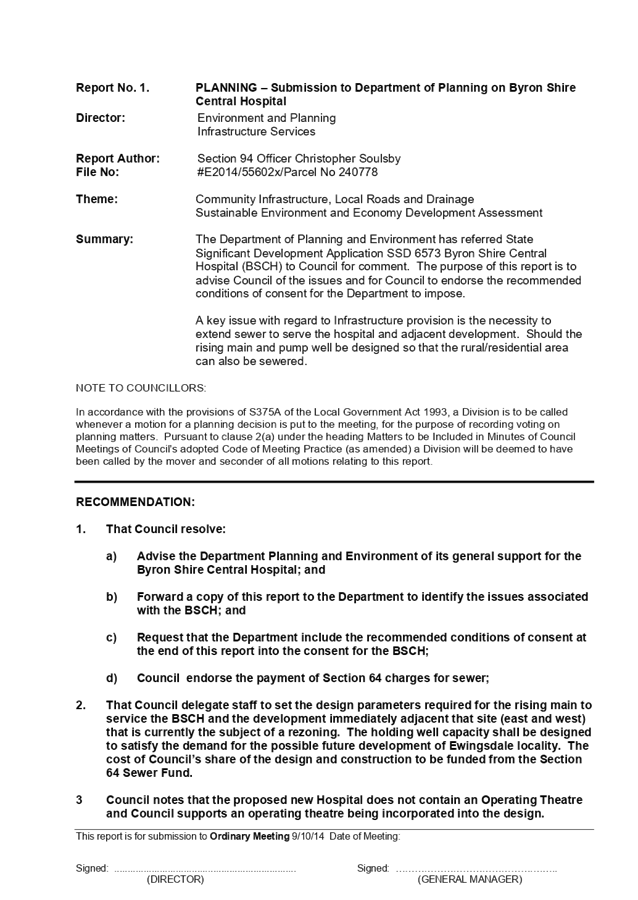
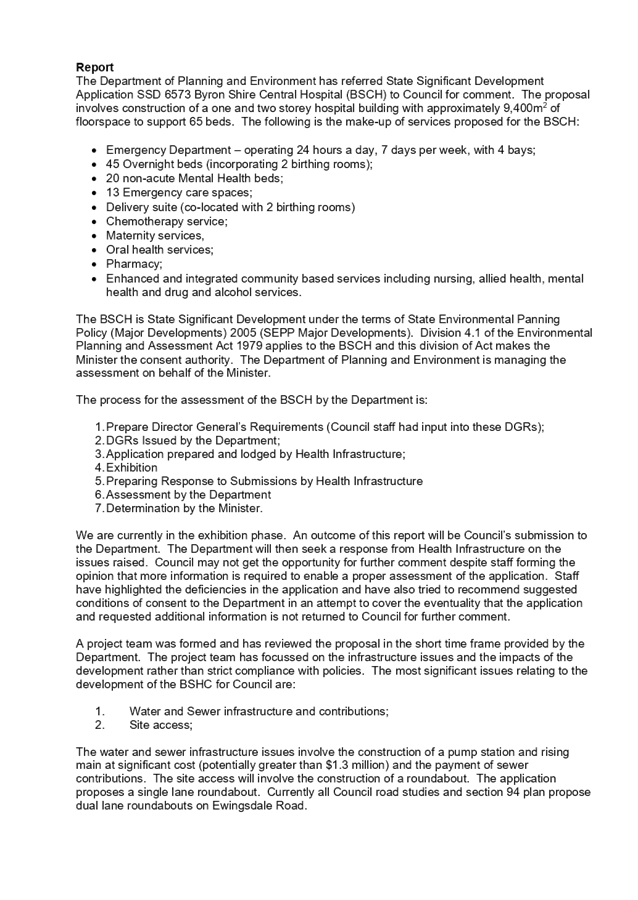
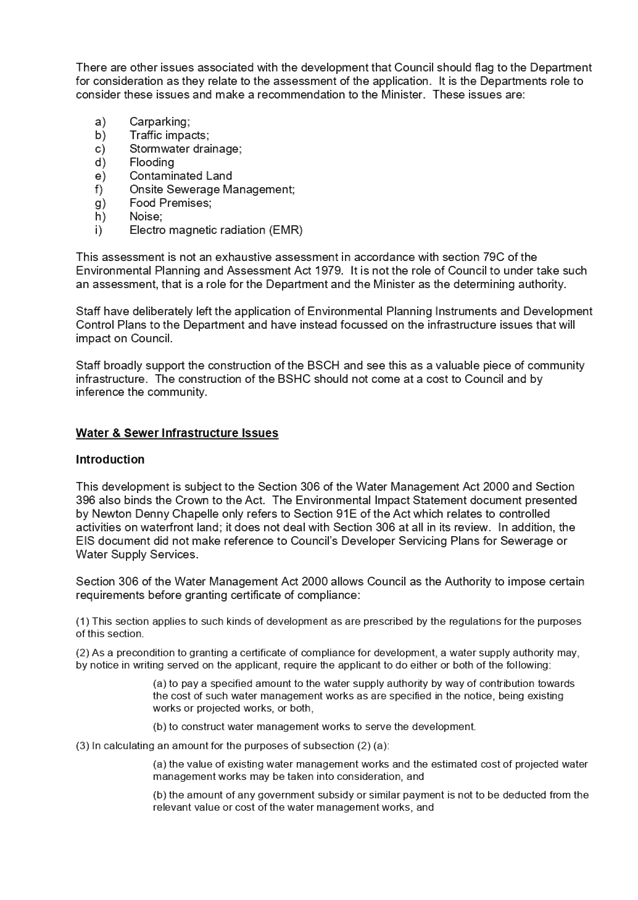
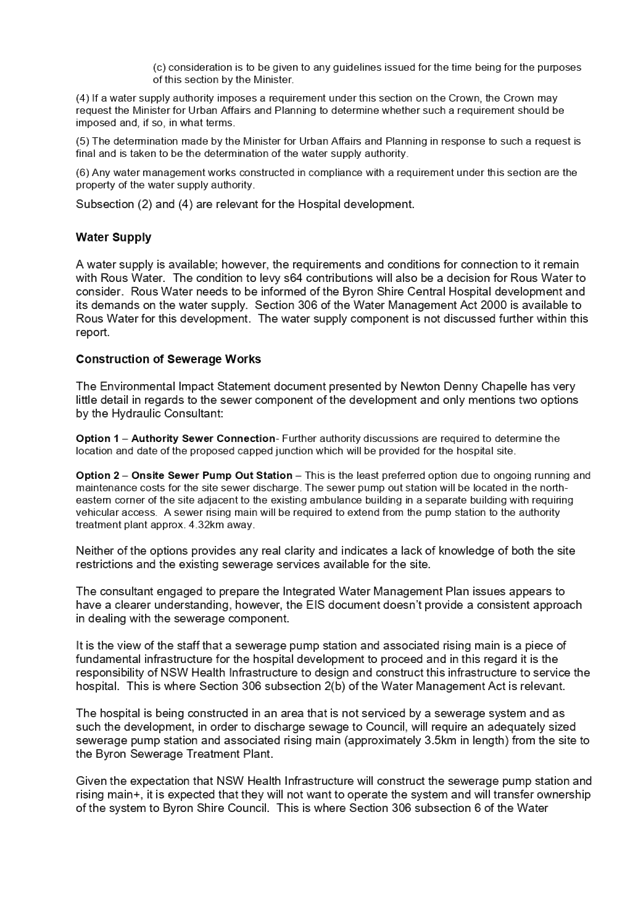
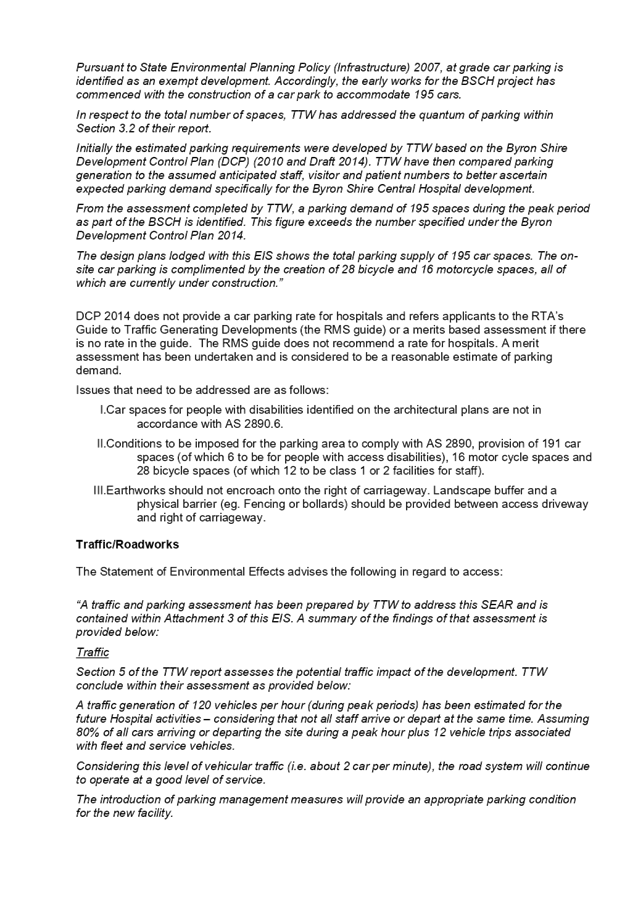
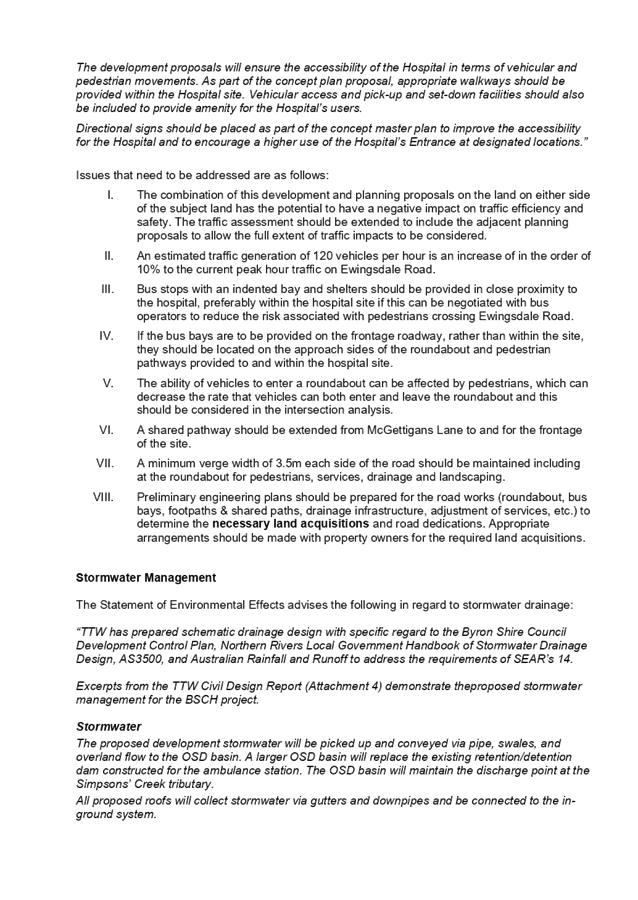
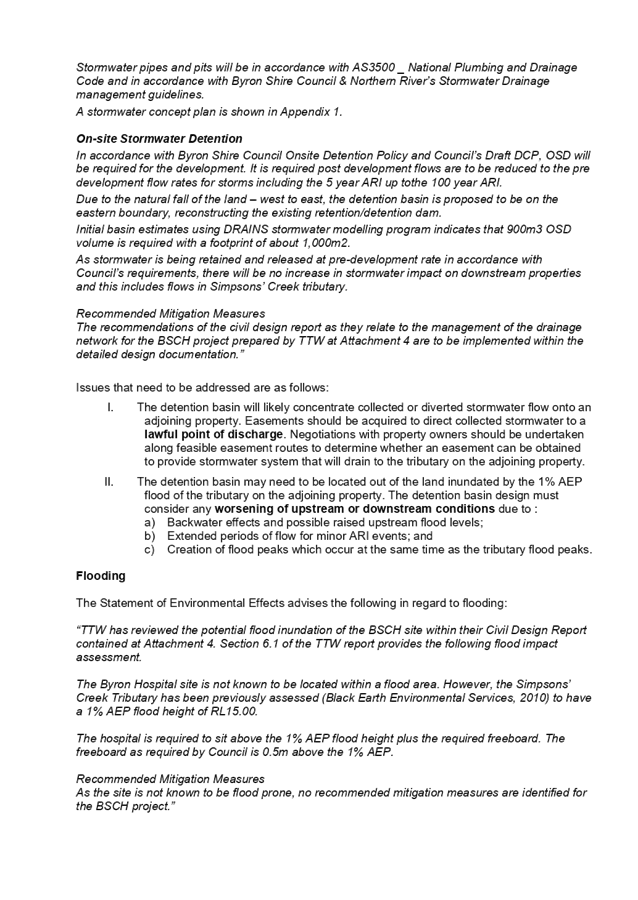
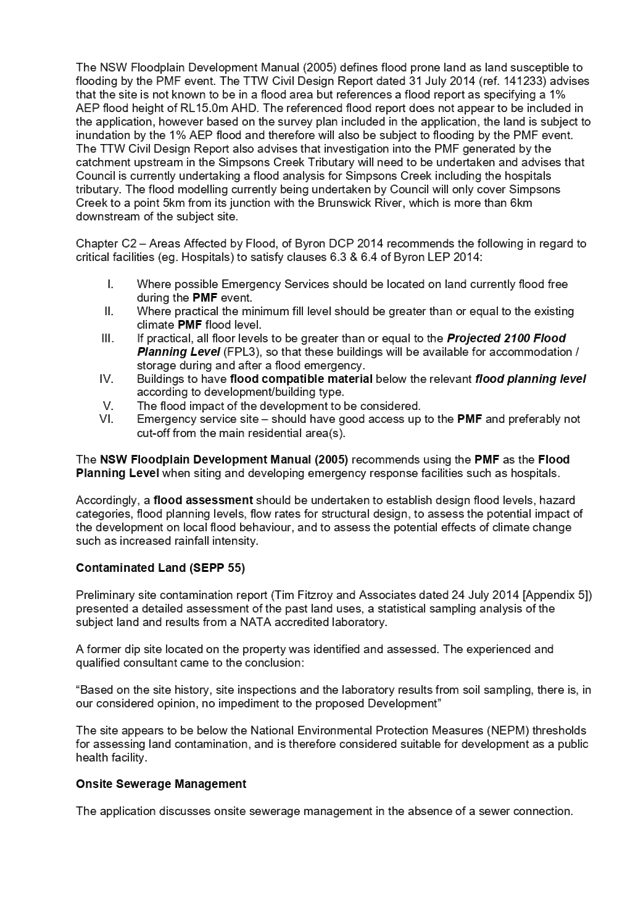
At the ordinary meeting of 9 October 2014 Council considered
a report on state significant development application SSD 6573 Byron Shire
Central Hospital (E2014/55602) provided as attachment 1.
Council resolved at minute 14-502
1) That Council:
a) Advise the Department
Planning and Environment of its general support for the development of a Byron
Shire Central Hospital (BSCH); and
b) Forward a copy of
this report to the Department to identify the issues associated with the BSCH;
and
c) Forward a copy of this
report to the media including a press release identifying the issues associated
with the BSCH.
d) Request that the
Department include the recommended conditions of consent at the end of this
report into the consent for the BSCH;
e) Endorse the payment
of Section 64 charges for sewer in accordance with the table at the top of page
44.
2) That Council delegate
staff to set the design parameters required for the rising main to service the
BSCH and the development immediately adjacent that site (east and west) that is
currently the subject of a rezoning. The holding well capacity shall be
designed to satisfy the demand for the possible future development of
Ewingsdale locality. The cost of Council’s share of the design and
construction to be funded from the Section 64 Sewer Fund.
3) That due to the
proposed new Hospital not containing an operating theatre providing surgical
services, which has always been considered essential by the Byron Shire
Community Consultative Committee in its support for a new facility, this
council cannot support the proposal in its current form.
(Spooner/Richardson)
Council resolved to future proof the pump well and rising
main at the Byron Central Hospital by giving it extra capacity. The hospital
needed 100 ET but for minimal extra cost 1000 ET capacity was provided in case
we ever wanted to sewer Ewingsdale. That infrastructure can sit their unused
but it would be very expensive to come back and upgrade it later.
The hospital rising main will now connect to the new West
Byron pump station. So it in turn needs to have the extra capacity.
RECOMMENDATION:
That Council notes the report.
Attachments:
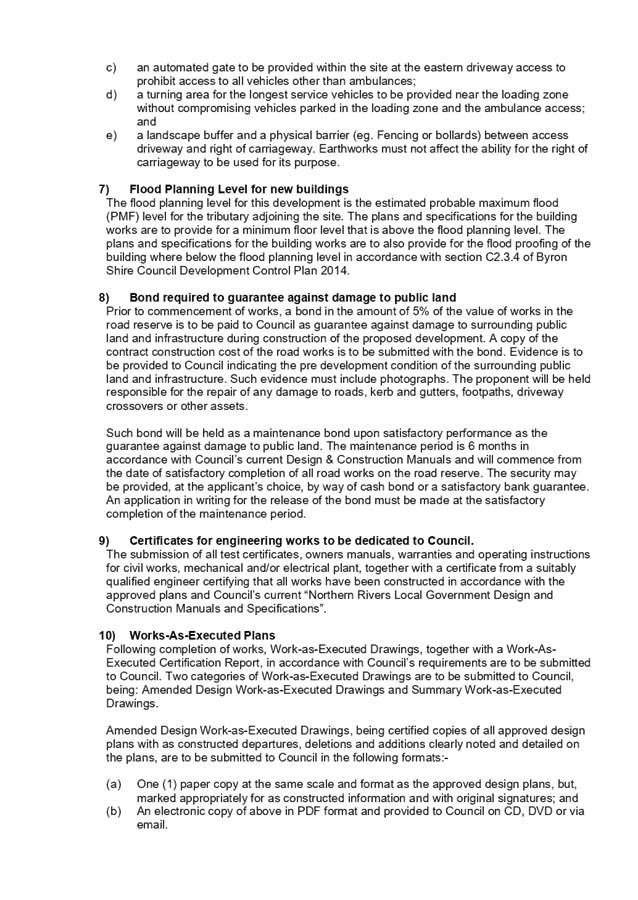
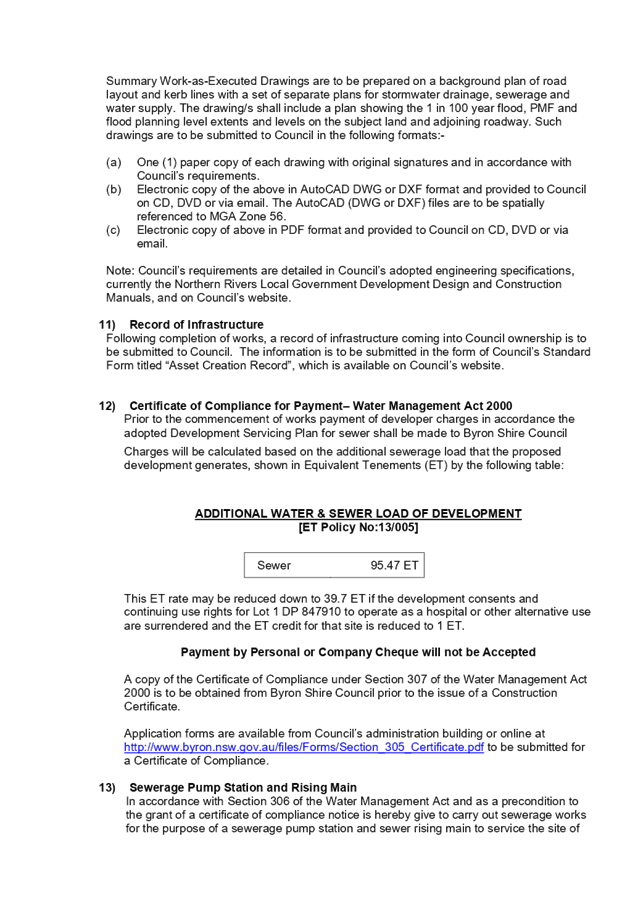
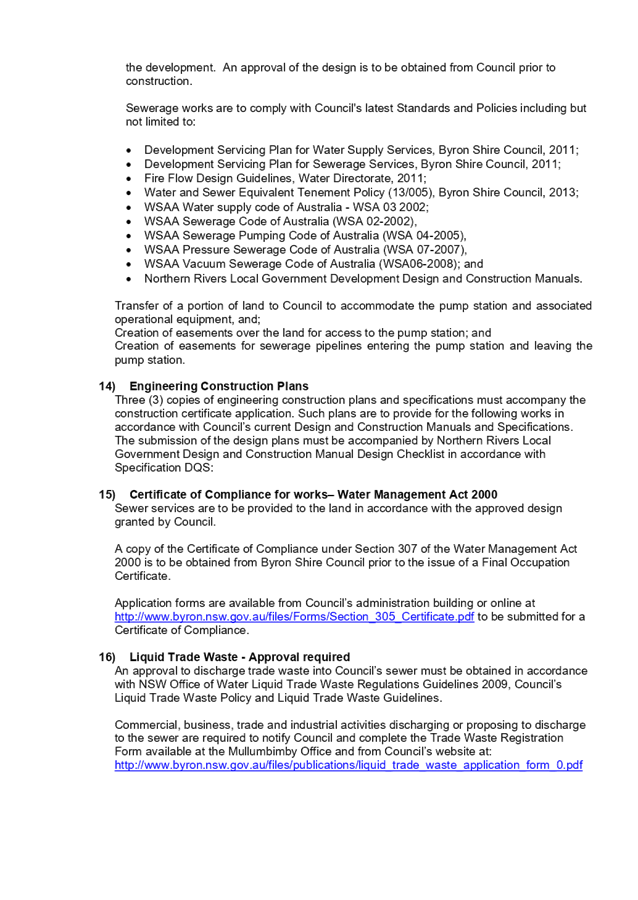
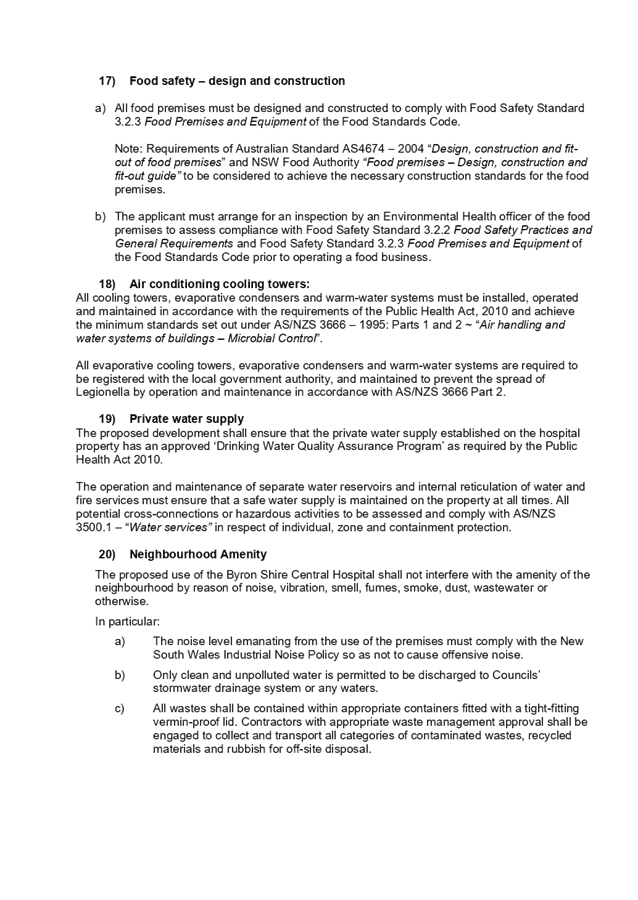
1 Report
Ordinary - submission to Department of Planning submission on Byron Central
Hospital Ewingsdale Hospital, E2014/55602
, page 17⇩ 
Staff
Reports - Sustainable Environment and Economy 4.1 - Attachment 1


Staff Reports - Infrastructure Services 4.2
Staff Reports - Infrastructure Services
Report No. 4.2 Mullumbimby
Future Water Strategy
Directorate: Infrastructure
Services
Report Author: Dean
Baulch, Principal Engineer, Systems Planning
File No: I2021/478
Summary:
To provide information relating to the development of a
Future Water Supply Strategy for Mullumbimby.
The key issue to be addressed is water supply security
(servicing existing customers and future development over the long-term).
The current demand for water in Mullumbimby is virtually equal to the current
secure yield at Laverty’s Gap weir and if the worst drought on record
were to repeat, the current supply may not meet demand.
Based on the Triple Bottom Line assessment, the most
favourable scenario is a permanent connection to the Rous regional supply.
RECOMMENDATION:
That the Committee:-
1. Note
the report.
2. Allow
Council to consider the preferred strategic direction of staff to facilitate
the start of detailed works.
Report
Information/Background:
Mullumbimby’s drinking water supply is extracted from
Laverty’s Gap Weir on Wilsons Creek where it flows by gravity through an
open channel, via a mountain tunnel to the Mullumbimby water treatment plant
(WTP) as shown on Figure 1. The channel and tunnel were the original raw
water transfer system to the Mullumbimby Hydroelectric Power Station (now
decommissioned). The Mullumbimby water supply currently services
approximately 1,620 residential properties (3,200 people) and 270
non-residential properties. Approximately 13 customers along Wilsons
Creek Road are connected to the trunk main from the WTP.
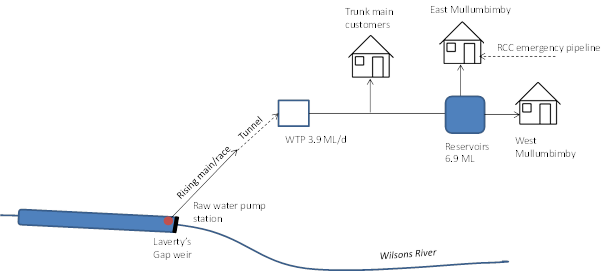
Figure 1:
Mullumbimby water supply schematic diagram
Council engaged Hydrosphere Consulting to prepare a
long-term strategy for Mullumbimby water supply. The key issue to be
addressed is water supply security (servicing existing customers and future
development over the long-term). The current demand for water in
Mullumbimby is virtually equal to the current secure yield at Laverty’s
Gap weir and if the worst drought on record were to repeat, the current supply
may not meet demand. Council has prepared growth management strategies
for urban land, rural areas and business/industrial land which include future
development that will increase the demand for potable water.
The water supply strategy also considers the following
issues:
· Asset
condition and performance – the raw water channel (constructed in the
1920s) has exceeded its useful life. The likelihood of failure is considered
very high and on the basis that structural failure of the channel would cause
extended interruption to the water supply, upgrading the raw water transfer
system is a high priority. In addition the Mullumbimby WTP (originally
constructed in 1940), requires replacement in the next five to ten years and
short-term options are required to ensure removal of pathogens.
· Drought
management and emergency response – restrictions are currently introduced
based on the water level and inflows in Laverty’s Gap weir. Restrictions
were imposed in Mullumbimby during the droughts of 2002/03, 2006/07 and
2019/20. An emergency supply from the Rous County Council regional supply can
supply water to lower elevation areas (East Mullumbimby) and was used for 30
days during summer 2019/20.
· Heritage
considerations and management obligations – Laverty’s Gap weir and
the channel (as part of the Mullumbimby hydro-electric power complex) are
listed on the NSW State Heritage Register. In addition, the WTP has heritage
significance at a local level.
This report assesses the security of the existing water
supply system based on its secure yield and current demand. Options to
increase the supply and reduce potable water demand have been identified and
analysed and scenarios have been developed using combinations of the options to
achieve the required secure yield in 2050. An integrated water cycle
management (IWCM) approach has been used to compare options and scenarios and
identify the preferred supply augmentation scenario to meet the predicted 2050
demand. Community consultation has not yet been undertaken.
Secure
Yield, Forecast Demand and Water Supply Security
‘Secure yield’ is defined
as the highest annual water demand that can be supplied from a water supply
headworks system whilst water restrictions are not too severe, not too
frequent, nor of excessive duration.
Mullumbimby’s demand for water is increasing with
development and population growth. The dry year unrestricted demand at 2050 is
predicted to be 754 ML/a (assuming water loss management activities are
successful). Water security is achieved if the secure yield of a water
supply is at least equal to the unrestricted dry year annual demand. The
RCC emergency supply pipeline improves the water supply security although it is
not intended to operate any more than an emergency supply. The supply is
currently secure until 2027 (Figure 2). The supply deficit at 2050
(excluding the emergency supply) will be 377 ML/a.
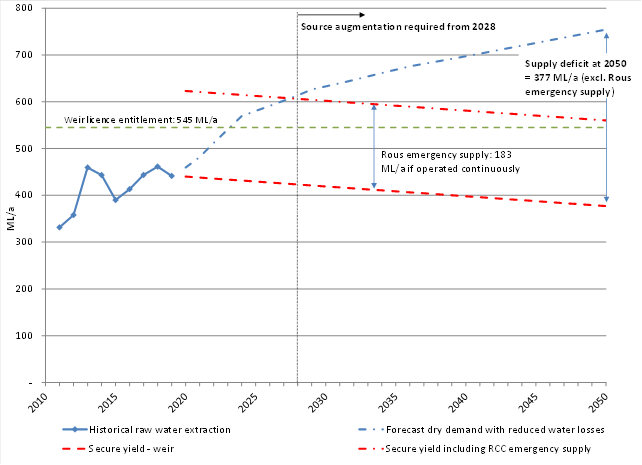
Figure 2: Comparison of forecast raw water demand, licence
entitlement and secure yield
Water
Supply Options and Supply Scenarios
A coarse
screening assessment considered a range of new as well as previously identified
supply options. Short listed supply-side options are:
Option 1. Do
nothing (assessed for comparison with augmentation options).
Option 2. Raising
Laverty’s Gap weir.
Option 3. Off-stream
storage.
Option 4. A:
Permanent connection to the RCC bulk water supply.
B: Emergency connection to regional
supply
Option 5. Groundwater.
Following a detailed assessment
of these options, raising Laverty’s Gap weir was not recommended for
further consideration due to the minimal yield benefit, high costs and
significant impacts on terrestrial biodiversity as well as downstream users and
the environment.
Four supply scenarios have been developed from combinations
of the options that achieve the required secure yield over the long-term (754
ML/a, an increase of 377 ML/a at 2050). All scenarios include the following
common components in the short-term:
· Continued
use of the weir supply and WTP in the short term: the existing supply from
Laverty’s Gap weir and the existing WTP will continue to operate and
supply treated water to Mullumbimby in the interim until a long-term solution
is implemented and operational.
· WTP
short-term upgrades: required to ensure microbially safe water is delivered to
residents. Short-term upgrades are recommended regardless of the water supply
augmentation scenario adopted. These are estimated to cost $380,000 (plus BSC
labour) over the next 5 years.
· Continued
operation of the RCC emergency supply pipeline: The emergency supply pipeline
currently connects the Mullumbimby reticulation network to the RCC regional
supply with up to 0.5 ML/d distributed the low-lying areas of the town during
emergency drought situations. This pipeline should be extended so that an
emergency supply is available for all customers.
· Increase
in the licence extraction limit: Consultation with DPIE to secure an increase
in the weir licence extraction limit which may be required from 2023 depending
on the reliance on the supply from the weir (refer Figure 2).
· Review
and update of the drought management plan based on the performance of the
supply and drought management regime during the recent drought.
· Urban
effluent reuse opportunities: Continued identification and implementation of
urban effluent reuse opportunities to reduce future demand and the yield
deficit.
· Implementation
of the demand management measures in the Regional Demand Management Plan
(including rainwater tank rebates, the Sustainable Water Partner Program, smart
metering and community engagement and education) and Council’s water loss
reduction measures.
· Continued
investigation of the long-term impacts of climate change on the secure yield of
the weir supply.
· Rehabilitation
of the raw water channel to preserve heritage. The heritage requirements are
being identified in a separate study.
The potentially feasible water supply
augmentation scenarios are:
· Scenario
S1: Base case: Improvements to the existing raw water transfer system, a
new WTP and full emergency connection to the regional supply. This scenario
would provide secure yield until 2025. Beyond 2025, restrictions may become
more frequent and/or more severe.
· Scenario
S2: Off-stream storage: Improvements to the existing raw water transfer system,
full emergency connection to the regional supply, construction of a 200 ML
off-stream storage and new WTP. High stream flows (excluding an allowance for
environmental flows) would be transferred to fill the off-stream storage. Water
from the storage will be treated at the new WTP and transferred to the
township.
· Scenario
S3: Permanent connection to RCC regional supply: In this scenario,
Mullumbimby would form part of the RCC regional supply network with bulk
treated water transferred to the Azalea Street reservoirs. The weir supply and
Mullumbimby WTP would become redundant but may be retained by RCC to supplement
the regional supply.
· Scenario
S4: Supplementary groundwater: Improvements to the existing raw water
transfer system, a new WTP, full emergency connection to the regional supply,
construction of new bores to the south-west of Mullumbimby with raw water
transferred either to the weir or a new groundwater WTP for treatment and
distribution to the township.
The preferred option to upgrade the raw water transfer
system from the weir (for S1, S2 and S4) is a new pumped pressure pipeline
following an alternative alignment that is independent of the channel.
The channel would be retained and operate in combination with the new main.
The four scenarios have been compared using a
triple-bottom-line (TBL) assessment which assesses each scenario based on
environmental, social and economic criteria. Based on the TBL assessment, the
most favourable scenario is S3: Permanent connection to RCC regional supply (Figure 3). This scenario would have minimal
environmental impact and the security of supply is only limited by the security
of the RCC regional supply. The net present value of this scenario is similar
to S1: Base Case and S4: Groundwater and significantly less than S2: Off-stream
storage. There are significant cost savings in avoiding the need to replace the
Mullumbimby WTP and upgrade the weir supply.
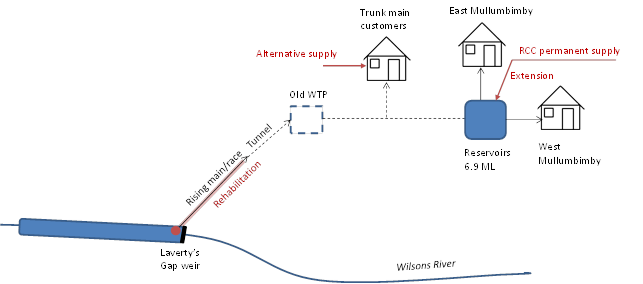
Figure 3:
Preferred scenario S3: Permanent connection to RCC regional supply
Implementation
Plan
The following actions are required to
progress the implementation of the preferred scenario:
· Construction
of extension to emergency pipeline.
· Consultation
with the community.
· Consultation
with Rous County Council.
· Consultation
with state government agencies (e.g. NRAR, DPI – Fisheries).
Other actions being conducted in parallel are:
· Statement
of heritage impact.
· Urban
water metabolism project (review and update of recycled water management
strategy).
· Short-term
upgrades to the WTP.
Risk:
A number of risk ratings
are likely to increase if an adequate water supply for the future is not
secured, these relate to the Strategic Risk Register and the following
references:
· 1. Asset and Infrastructure Management
· 2. Essential Services
· 5. Urban Planning
Consultation:
|
Who was
consulted?
|
How did
consultation occur? e.g. email, verbal etc
|
Comments/Feedback
|
|
Council Executive Team
|
ET Report and Presentation
|
Executive Team was updated on progress March 2021
|
|
SEE Key Planners
|
Meeting/Verbal
|
To be updated on progress after ET informed.
|
Communicate to: Utilities Team to continue formal
communication with SEE Planners (Residential Strategy) and Executive Team.
Strategic Considerations
Community Strategic Plan
and Operational Plan
|
CSP Objective
|
L2
|
CSP Strategy
|
L3
|
DP Action
|
L4
|
OP Activity
|
|
Community
Objective 1: We have infrastructure, transport and services which meet
our expectations
|
1.5
|
Provide
continuous urban water and sewerage services within the Shire
|
1.5.3
|
Ensure Water
Supply is maintained in accordance with NSW Health guidelines
|
1.5.3.2
|
Implement
recommendations from Mullumbimby water supply security investigations and
upgrade
|
Financial Considerations
Current budget and planned budgets from 30 year Capital
works plan shown as follows:
|
Year
|
WATER FUND - CAPITAL WORKS PROGRAM AND FUNDING
|
Budget
|
|
2020/2021
|
Mullum water supply security investigations and upgrade
|
$235,200
|
|
2020/2021
|
Mullumbimby WTP - Renewals
|
$50,000
|
|
2021/22
|
Mullum water supply security upgrade
|
$2,000,000
|
|
2021/22
|
Mullumbimby WTP - Renewals
|
$15,000
|
|
2022/23
|
Mullumbimby WTP - Renewals
|
$589,800
|
|
2025/26
|
Mullumbimby WTP - Renewals
|
$35,500
|
|
2026/27
|
Mullumbimby WTP - Renewals
|
$74,000
|
|
2026/27
|
Mullum water supply security upgrade
|
$2,449,000
|
|
TOTAL
|
$5,448,500
|
Based on the Triple Bottom Line assessment,
the most favourable scenario is: S3: Permanent connection to RCC regional
supply. There are significant cost savings in avoiding the need to
replace the Mullumbimby WTP and upgrade the weir supply.
Staff Reports - Infrastructure Services 4.3
Report
No. 4.3 Byron STP
Condition 9 Additional Load - Quarterly Report
Directorate: Infrastructure
Services
Report Author: Dean
Baulch, Principal Engineer, Systems Planning
Vivianne Lins, Environmental Planner
File No: I2021/605
Summary:
This report is for the Committee’s information
and reviews compliance with the Byron Bay
Sewerage Augmentation Scheme - Conditions of Approval
(2002).
Condition 9(iii) requires that sufficient reuse
(recycled water) capacity be available before the acceptance of any additional
load at the treatment plant.
In the years since the approval was granted (2002 to
date), 2,749 Equivalent Tenements (ET) have
been approved, resulting in an additional load of
1.622 ML/day at the treatment plant. The current
day operating capacity of the reuse system equates to
2.02ML/day or 3,427ET. Therefore the
reuse system provides sufficient capacity to
accommodate the additional load as defined in the Conditions of Approval.
RECOMMENDATION:
That the report is noted.
REPORT
The relevant section from
Condition 9 of the Approval is Condition 9(iii), which states,
“Additional load at West Byron STP will not be accepted until:
availability of sufficient reuse capacity to accommodate 100% of the volume of
treated effluent generated by the additional load”.
“Additional Load”
is defined in the report as “any sewage load resulting from development
consents after the date of this approval”. Date of Approval is 9
December 2002.
From December 2002 through to
the end of March 2021, 2,749 additional sewer Equivalent Tenements (ET) have
been approved by Council through development consents. This additional
load (including approvals for secondary dwellings) was also adjusted (reduced)
based on development applications that have been withdrawn or refused during
the same period. Figure 1 shows the annual approved additional ET load from
2002 to 2021.
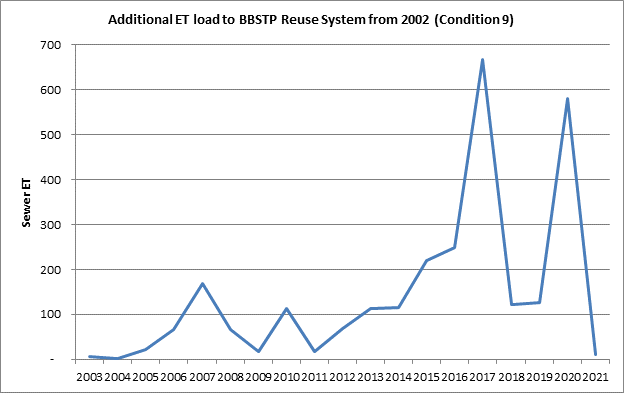
Figure 1 - Equivalent Tenements approved by Council from
2002-2021
The current day operating
capacity of the reuse system to produce treated effluent is 26 Litres per
second or 2.25ML/day less 10% of water for filter backwash purposes equates to
2.02ML/day or 3,427ET.
|
|
Current Approved
ET
|
Available Capacity
(ET)
|
|
Condition
9(iii) Additional Load Calculation
|
2,749
|
-
|
|
Current
effluent reuse system capacity 2020
|
3,427
|
678
|
Therefore, the
existing reuse system provides sufficient capacity to accommodate the additional load as defined in the Conditions of
Approval.
|
Committee
Report Tracking Summary:
Condition 9. Additional Load at Byron STP
|
Current Approved
ET
|
Difference
(ET)
|
|
30
January 2020
|
2,408
|
-
|
|
30 July
2020
|
2,478
|
70
|
|
29
October 2020
|
2,508
|
30
|
|
18 February
2021
|
2,738
|
230
|
|
29 April
2021
|
2,749
|
11
|
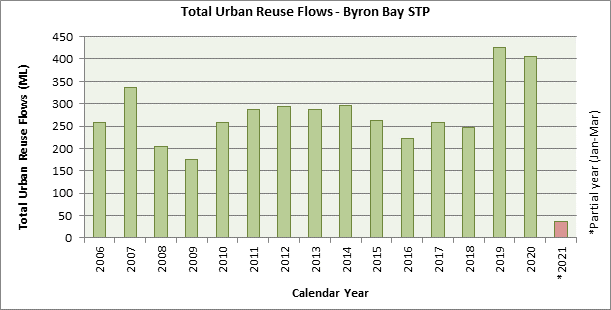
In terms of the actual reuse
volumes for Byron Bay since the system was commissioned the following annual
figures are provided:
|
Calendar Year
|
Total Urban Reuse Flows (ML)
|
|
2006
|
258.8
|
|
2007
|
336.1
|
|
2008
|
204.4
|
|
2009
|
174.5
|
|
2010
|
257.2
|
|
2011
|
287.4
|
|
2012
|
294.0
|
|
2013
|
287.2
|
|
2014
|
296.9
|
|
2015
|
261.9
|
|
2016
|
221.8
|
|
2017
|
257.3
|
|
2018
|
246.7
|
|
2019
|
424.7
|
|
2020
|
405.2
|
|
*2021
|
96.2
|
Staff Reports - Infrastructure Services 4.4
Report
No. 4.4 Ocean Shores
transfer to Brunswick Valley STP
Directorate: Infrastructure
Services
Report Author: Dean
Baulch, Principal Engineer, Systems Planning
File No: I2021/615
Summary:
Council has had recent
correspondence and meetings with NSW Environment Protection Authority (EPA)
regarding compliance with licence conditions at Ocean Shores STP – The
EPA has completed a Environmental Risk Assessment and raised the risk rating of
the Ocean Shores system from medium to high due to concerns around treatment
performance.
Council is now at a decision point relating to Ocean Shores
STP.
RECOMMENDATION:
That the status report be noted
Report
This is a status update for information:
Council has had recent correspondence and meetings with NSW
Environment Protection Authority (EPA) regarding compliance with licence
conditions at Ocean Shores STP – The EPA has completed a Environmental
Risk Assessment and raised the risk rating of the Ocean Shores system from
medium to high due to concerns around treatment performance.
Council is now at a decision point relating to Ocean Shores
STP.
Ocean Shores STP operates under a relatively old NSW EPA
environmental licence. The concentration limits of this licence are relatively
lenient (e.g. in respect of ammonia) compared with more modern licences for
similar sized plant in the region (e.g. Brunswick Valley STP). Similarly,
the mass load limits for nutrients (e.g. Total N), when converted to likely effective
average concentrations based on average flow estimates, are relatively lenient.
At Council’s Ordinary Meeting of 22 June 2017 it was
resolved to investigate operational risks cited in the GHD Study and report
back to Council via the Committee on the Ocean Shores Transfer to Brunswick
Valley STP Option 4.
The risk assessment for Option 4 was finalised by GHD in
December 2017 and identified the most significant risks and appropriate
mitigation.
The Option 4 transfer of sewage from Ocean Shores to Brunswick
Valley STP also represents a significant financial saving to Council in the
longer term.
From Council Meeting of 19 April
2018, Resolution: 18-278
That Council adopt the following
Committee Recommendation(s):
The Committee have a workshop to further consider Ocean
Shore Sewage Transfer Risk Assessment including:
a) An
up-to-date assessment of the capacity of the OS STP
b) Sensitivity
of whole-of-life cost assessment of options for BVSTP and OSSTP to reduced
augmentation requirements at OS STP
c) Projection
of comparative nutrient loads to the Brunswick River and under the Option 4 and
Option 1 scenarios
Items a) & c) are now
complete. They are not attached to this report as they are large
technical reports. Item b) needs to be updated in today’s dollars.
Staff recommend that Council proceed to detailed design
phase for Option 4 of an upgraded plant at Brunswick Valley STP
Key issues
· Compliance with NSW EPA Licence requirements
· Performance of the Ocean Shores STP
· Link to the Mullumbimby Water Supply Strategy relating to
reuse water opportunities for Mullumbimby
Next steps
· Require direction from Council. Committee Workshop.
Strategic Considerations
Community Strategic Plan
and Operational Plan
|
CSP Objective
|
L2
|
CSP Strategy
|
L3
|
DP Action
|
L4
|
OP Activity
|
|
Community Objective 1: We
have infrastructure, transport and services which meet our expectations
|
1.5
|
Provide continuous urban water
and sewerage services within the Shire
|
1.5.2
|
Ensure Wastewater Treatment
Plants are maintained in accordance with operating licences
|
1.5.2.1
|
Monitor and compile annual
licence returns
|
Legal/Statutory/Policy
Considerations
Compliance with NSW EPA Licence conditions.
Financial Considerations
The capital cost of Option 4, is estimated to be $10
Million. This is a significant saving to the community in both initial capital
and whole of life costs.
An upgrade of Ocean Shores STP alone has a capital cost of
$29 Million.
On Net Present Value terms Option 4 has the potential to
save Council up to $18 Million. In general, a transfer of Ocean Shores to
Brunswick Valley STP provides an NPV saving in the $Millions.
Staff Reports - Infrastructure Services 4.5
Report
No. 4.5 Inflow and
Infiltration - April 2021 update
Directorate: Infrastructure
Services
Report Author: Jason
Stanley, Inflow & Infiltration Project Manager
File No: I2021/616
Summary:
Environmental Data Services (EDS) are planning to provide a
presentation to the committee covering the sewer flow metering performed within
Mullumbimby.
This report provides Average Dry Weather Flows that are to
be referred to for future Inflow and Infiltration reporting until such time
that a modern day industry standard can be utilised for each STP.
RECOMMENDATION:
1. That
the committee:
a) Note
the presentation from Environmental Data Services
b) Notes
the interim Average Dry Weather Flow values which will trigger inflow and
infiltration reporting until such time that Average Dry Weather Flows are
available using a modern day industry method.
Report
The following is an extract of the request for information
received from Duncan Day, dated Thursday 1st April 2021:
For reporting to our next
Committee meeting, could the following daily data be presented for BVSTP
please?
A matrix (spreadsheet would be
great) for
(i) the
five days used to establish ADWF, and
(ii) the
wet days 17 to 25 March, with the following figures:
1. daily inflow to the STP;
2. individual sewer catchment
pump station pump hours and flows (if conversion of hours to kL/day is known).
Average Dry Weather Flow (ADWF)
Please refer to Council resolution 20-054 from 27th
February 2020:
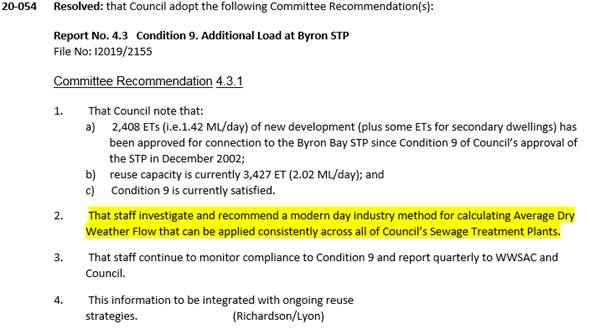
It is understood that this ADWF investigation will be
reported to the next scheduled WWSAC meeting. Until these ADWF’s have
been identified, interim values will be used purely for the basis for future
reporting where a daily inflow to an STP has exceeded its ADWF by factor of 10
or more.
This interim measure will utilised the dry weather flow
definition as per Council’s Water and Sewer Equivalent tenement policy
which states:
The average daily flow to the treatment works during
seven consecutive days without rain (excluding a period which includes public
holidays) following seven days during which the rainfall did not exceed 0.25
millimetres on any one day.
Referring to the Bureau of Meteorology’s Climate Data
Online database, the most recent event which meets these criteria is 17th
to 24th November 2020. Screenshots of daily rainfall recorded at
Mullumbimby (Fairview Farm) and Byron Bay (Cape Byron AWS) are provided below.
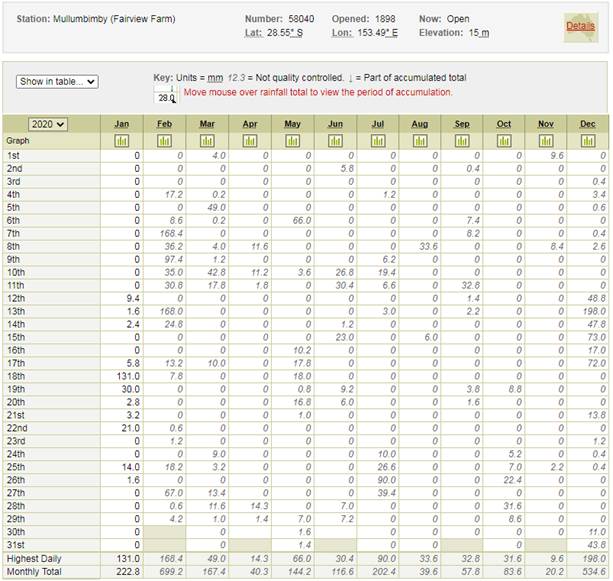
Figure 1 -
Daily Rainfall for 2020, Mullumbimby Station #58040, Source: Bureau of
Meteorology
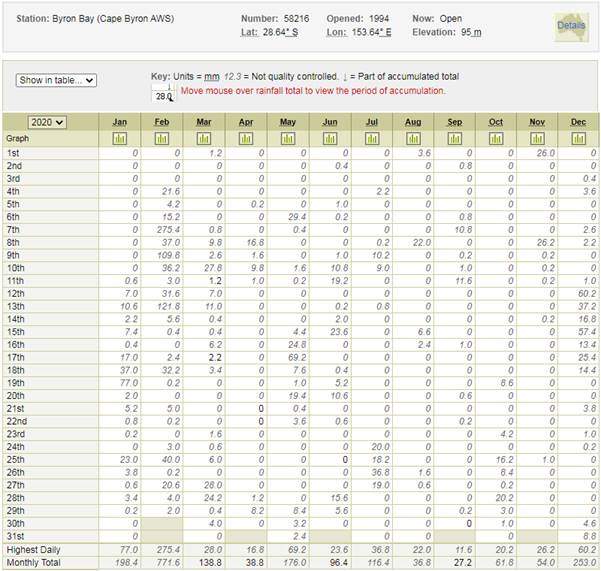
Figure 2 -
Daily Rainfall for 2020, Byron Bay Station #58216, Source: Bureau of
Meteorology
Data for inflows into each STP at this time has been
extracted and placed into the following table:
|
Utility
|
Byron Bay STP
|
Bangalow STP
|
Brunswick Valley STP
|
Ocean Shores STP
|
|
Parameter
|
Total Daily Inflow
|
Inlet Flow Total
|
Total Daily Inflow
|
Total Daily Inflows
|
|
Units
|
kL
|
kL
|
kL
|
kL
|
|
|
|
|
|
|
|
|
|
|
|
|
|
|
|
|
|
|
|
|
|
Date
|
Value
|
Value
|
Value
|
Value
|
|
17/11/2020
|
4630.60
|
380.00
|
1237.45
|
1306.11
|
|
18/11/2020
|
4623.66
|
376.00
|
1217.26
|
1291.18
|
|
19/11/2020
|
4740.49
|
259.00
|
1219.50
|
1308.24
|
|
20/11/2020
|
4844.33
|
377.00
|
1257.91
|
1289.76
|
|
21/11/2020
|
4684.12
|
359.00
|
1253.51
|
1323.92
|
|
22/11/2020
|
4650.51
|
353.00
|
1258.30
|
1353.18
|
|
23/11/2020
|
4689.04
|
382.00
|
1245.76
|
1328.00
|
|
|
|
|
|
|
Average
|
4694.68
|
355.14
|
1241.38
|
1314.34
|
Therefore, interim ADWF to use for
reporting Inflow and Infiltration for each STP site are as follows:
Bangalow STP 355
kL / day
Brunswick Valley STP 1,241
kL / day
Byron Bay STP 4,695
kL / day
Ocean Shores STP 1,314
kL / day
Individual sewer catchment pump station pump hours and
flows
An excel spreadsheet (Council reference
#E2021/56975) will be provided with the WWSAC agenda which provided individual
pump station pump hours and flows.
Daily Inflow into the Brunswick Valley STP
Data for inflows into the Brunswick Valley STP has been
extracted and placed into the following table:
|
Date
|
Brunswick
Heads
|
Mullumbimby
|
Total
Inflows (kL)
|
|
1/03/2021
|
646.0
|
1418.4
|
2064.4
|
|
2/03/2021
|
649.2
|
1380.6
|
2029.8
|
|
3/03/2021
|
603.1
|
1392.2
|
1995.3
|
|
4/03/2021
|
862.6
|
3096.7
|
3959.2
|
|
5/03/2021
|
738.6
|
1754.2
|
2492.8
|
|
6/03/2021
|
664.0
|
2126.2
|
2790.2
|
|
7/03/2021
|
714.5
|
1530.5
|
2245.0
|
|
8/03/2021
|
667.7
|
1609.5
|
2277.2
|
|
9/03/2021
|
762.9
|
4734.3
|
5497.1
|
|
10/03/2021
|
702.0
|
4389.6
|
5091.6
|
|
11/03/2021
|
930.5
|
6948.2
|
7878.8
|
|
12/03/2021
|
834.8
|
3762.2
|
4597.0
|
|
13/03/2021
|
817.5
|
2649.8
|
3467.3
|
|
14/03/2021
|
728.6
|
2178.5
|
2907.1
|
|
15/03/2021
|
951.2
|
6400.2
|
7351.4
|
|
16/03/2021
|
859.0
|
5046.4
|
5905.4
|
|
17/03/2021
|
912.0
|
5046.3
|
5958.3
|
|
18/03/2021
|
1163.2
|
5046.3
|
6209.5
|
|
19/03/2021
|
1080.2
|
6898.0
|
7978.2
|
|
20/03/2021
|
1074.9
|
8438.5
|
9513.4
|
|
21/03/2021
|
2500.7
|
8438.6
|
10939.3
|
|
22/03/2021
|
2680.8
|
8438.6
|
11119.4
|
|
23/03/2021
|
2668.2
|
8438.6
|
11106.8
|
|
24/03/2021
|
1561.7
|
8323.7
|
9885.4
|
|
25/03/2021
|
1141.1
|
4294.4
|
5435.5
|
|
26/03/2021
|
1032.7
|
2864.9
|
3897.7
|
|
27/03/2021
|
966.7
|
2332.9
|
3299.6
|
|
28/03/2021
|
911.7
|
2002.4
|
2914.1
|
|
29/03/2021
|
828.8
|
1831.3
|
2660.1
|
|
30/03/2021
|
930.9
|
2745.9
|
3676.8
|
Staff Reports - Infrastructure Services 4.6
Report
No. 4.6 Item for
discussion - HuskeeSwap
Directorate: Infrastructure
Services
Report Author: Danielle
Hanigan, Team Leader Resorce Recovery and Quarry,
File No: I2021/617
Summary:
Request
from Cr.Coorey into the potential use of Huskee cups scheme in the Byron shire.
Report
In partnership with Make the Switch, Byron Shire Council
is providing the opportunity for cafes to apply for a funded reusable coffee
cup scheme.
In consultations with cafes, different barriers to
reusables were identified
Council has engaged 3 reusable cup schemes (Huskee Cup, Green Caffeen and Kuppa
Cup) and discussed how each could be implemented.
Expressions of interest have been sent out to selected cafes for feedback.
6 cafes have already responded that they would like to take part.
Advertisements will be run to invite more cafes to join.
Cafes will have to commit to the encouragement and acceptance of BYO cups and
containers.
The
project will be shire wide.
The reuseables schemes will be part of a larger campaign of ‘Byron loves
BYO’.
Background
The Make the Switch program funded by the EPA Better
Waste and Recycling Fund has assisted over 50 cafes to switch to more
sustainable packaging alternatives.
However single-use packaging is a major contributor to
waste in our shire. Single use takeaway packaging is overflowing in our public
place bins and can be easily replaced with reusables.
COVID-19 has contributed to even more single-use and has impacted how businesses operate, but there are plenty
of ways we can safely use reusables, which can be more hygienic than relying on
single use. Furthermore, despite seeing such an increase in the use of takeaway
items over the last 12 months of the pandemic, reusables were actually never
banned in New South Wales.
Our aim is to make reusables safe and accessible for residents and visitors,
while also encouraging business and customers to support 'bringing your own'
cup or container in all forms for all occasions.
Key issues
· To switch to more
sustainable packaging alternatives
· Single use takeaway
packaging is overflowing in our public place bins and can be easily replaced
with reusables.
· Aim is to make
reusables safe and accessible for residents and visitors
· Encouraging business
and customers to support 'bringing your own' cup or container in all forms for
all occasions
Next steps
· Finalising
consultations
· Hoping to have the
schemes and campaign up and running by the end of May
Strategic Considerations
The
reuseables schemes will be part of a larger campaign of ‘Byron loves
BYO’
Legal/Statutory/Policy
Considerations
Not Applicable
Financial Considerations
Partially
funded through Make the switch program which is funded through EPA Better Waste
and Recycling Fund
Consultation and Engagement
Initial
consultation and engagement with cafes in Byron, Bangalow and Mullumbimby with
scope to involve other areas throughout the shire.